Loading...
Coming Soon
EP003
15 min
Compliance
Episode 3/Compliance/Free/ 15 min
Your Responsibilities When AI Is in the Room
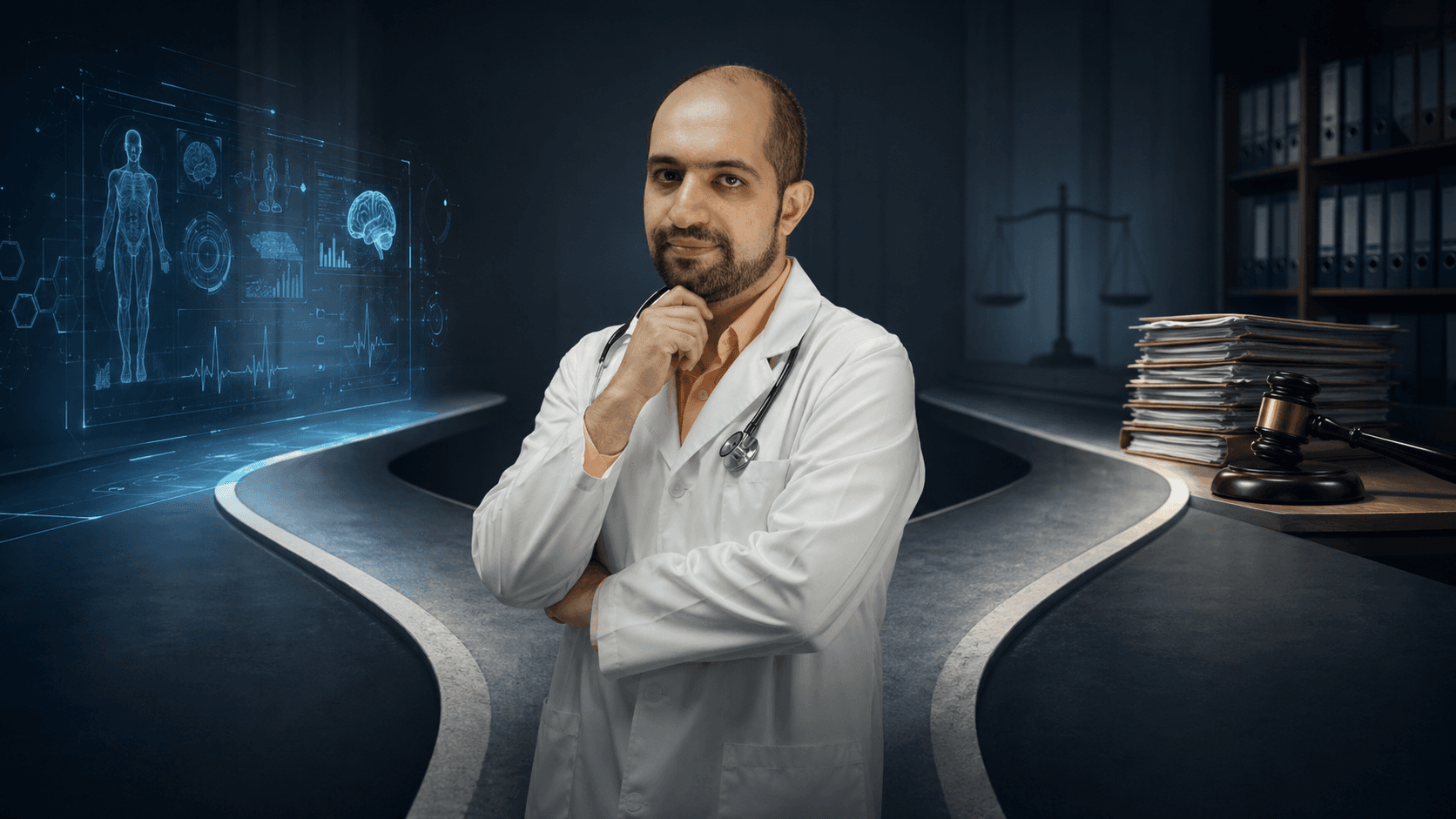
When AI generates a clinical note, suggests a diagnosis, or recommends a treatment — you're still the physician. Here's what that means for liability, documentation, and professional identity.
SZ
Dr. Sajad Zalzala
Physician & Technologist
IW
Isam Waqar
Product & Strategy
Show Notes
The most important thing to understand: AI does not reduce your responsibilities. It changes them.
The Legal Reality
- Your signature on an AI-generated note is a legal affirmation of every detail in that note
- 74.7% of mock jurors attributed negligence to physicians who used AI without independent review
- 64.1% of patients hold physicians accountable for errors in AI-generated documentation
- Malpractice carriers are adding AI-related questions to renewal applications
- State medical boards in California, New York, Texas, and Washington have issued AI guidance
Automation Bias — Your Biggest Risk
- Automation bias is the passive acceptance of AI outputs without critical evaluation
- When physicians used AI-assisted polyp detection, their unassisted detection rates declined — measurable deskilling
- 67% of physicians changed their treatment recommendation after seeing an AI suggestion
- The presence of decision support systems actually increased prescribing errors when the system was incorrect
- Top physician concerns: reduced vigilance (22%), deskilling of new physicians (22%), erosion of clinical judgment (22%)
What You Must Document
- Which AI tools were used in the encounter
- Whether the AI output was reviewed, modified, or overridden
- Your independent clinical reasoning — not just agreement with AI
- Any discrepancy between AI recommendation and your decision, with rationale
The Professional Identity Question
- AI is not replacing physicians — but it is changing what it means to be one
- The 'Clinician Plus' model: physicians who can critically evaluate AI alongside traditional clinical skills
- The most effective education model pairs physician-educators with technical experts
- 92% of physicians want this training. This is where you get it.
Transcript(click to expand)
Transcript will be available when this episode is published.
Newsletter
Get the most from this episode
Subscribe for show notes, transcripts, and CME styled resources delivered weekly.
Join 2,000+ physicians. Unsubscribe anytime.
Listen On